The Hidden Tax on Indian Ambition
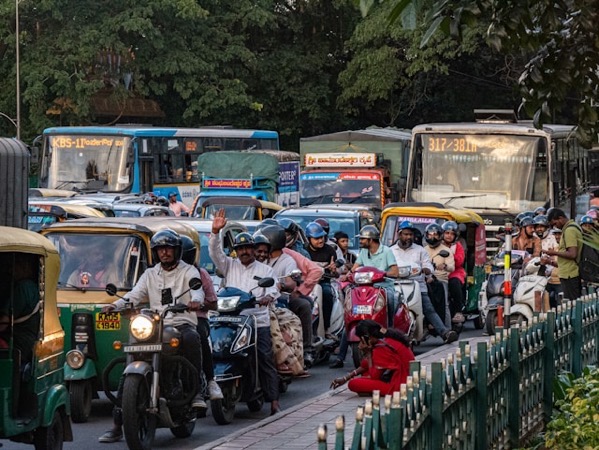
Lukas kienzler b3TAaBlBdps unsplash. Photo by Lukas Kienzler on Unsplash


I spent years losing time I'll never get back. In Bangalore, 117 hours a year stuck in traffic. In Delhi, 76 hours. That's nearly three full days annually spent breathing exhaust fumes, watching productivity evaporate, and feeling ambition slowly suffocate in gridlock.

This isn't just my story. It's the story of millions of Indians trapped in cities that generate wealth but can't govern themselves.

Last week's Economic Survey finally said what we've all been living: India's cities are "economically central but politically peripheral." The top 10 cities hold roughly 9% of the population but generate nearly 28% of GDP—a 3× output multiplier. Yet they raise less than 0.6% of GDP in own-source revenue. They can't tax. They can't borrow. They can't plan their own futures.

The survey's conclusion is damning: "Global cities compete; Indian cities comply."

We've Built a System That Punishes Success

Here's what that compliance looks like in practice: affordable housing in the top eight cities collapsed from 52% of new supply in 2018 to just 17% by 2025. People who build India's economic engine can't afford to live near where they work. So they move further out, where housing is cheaper and commutes are brutal. The congestion gets worse. The tax base hollows out. The cycle repeats.

Meanwhile, the Economic Survey gently suggests cities should "prioritize the movement of people, not vehicles." What it should say is this: we've turned our roads into parking lots for single-occupancy cars while buses remain inadequate and metro coverage stays patchy. First-mile and last-mile connectivity is still an afterthought. Other global cities introduced congestion pricing decades ago. We're still debating it.

Informality Isn't the Bug—It's the Only Thing That Works

The survey notes that "informality is not an aberration but a structural outcome of rapid urbanization under constrained formal systems." Translation: our formal systems are so broken that informal systems have to fill the gaps.

Door-to-door garbage collection covers 98% of wards today. Impressive statistic. But when informal sanitation workers left Gurugram during a labor dispute, garbage piled up overnight. The entire system depends on invisible labor that we refuse to properly integrate or compensate. We'd rather pretend informality doesn't exist than acknowledge that it's the only reason our cities function at all.

We're More Urban Than We Admit

Official Census data from 2011 claims India's urbanization rate is around 31%. Satellite data tells a different story: some regions are functionally above 80% urban when you measure actual settlement patterns instead of administrative boundaries. We're governing 21st-century megacities with frameworks designed for towns.

The Economic Survey concludes that cities need fiscal power, planning power, and enforcement power to move from managing growth to benefiting from it. I'd go further: until cities can tax properly, borrow meaningfully, reform land use, integrate transit, and take political ownership of outcomes, nothing will change. And nothing is changing.

Why I Left

I left India because I got tired of watching ambition collide with dysfunction. Tired of living far from work because that's where housing was affordable. Tired of infrastructure expanding while institutions stayed broken. Tired of hearing about potential that never materializes because the system is designed to disperse power and avoid accountability.

India will keep producing globally competitive talent from structurally constrained cities. And that talent will keep leaving—not because India lacks opportunity, but because its cities can't translate economic productivity into livable realities. Until that changes, the brain drain isn't a failure of ambition. It's a rational response to urban failure.

Defined tags for this entry: , ,


How to use flight tail numbers to track flights

This is a useful tool for people to check the status of a commercial flight using the tail number of the airplane, without the need to subscribe to any services. As a passenger, this is useful because you can see where the airplane scheduled to fly you is currently, which can help keep track of delays and cancellations.

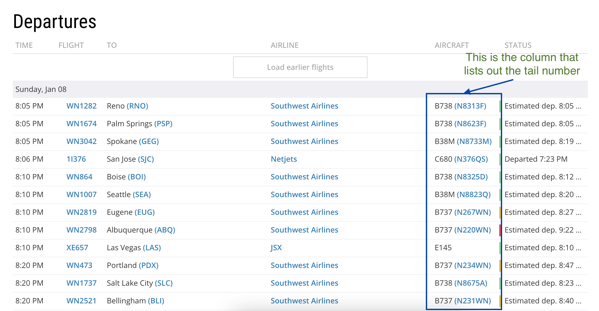
The first step is to find the tail number of the flight that you are scheduled to take. Head to the airports page of flightradar24 and get to the page of the airport that you will be flying out of. For example, if you are flying out of Oakland, California, this would be https://www.flightradar24.com/data/airports/oak. On that page, click the "Departures" tab. This will give a list of flights, along with their tail numbers.

Screen Shot 2023-01-08 at 8.23.29 PM.png

For example, assuming that you are flying on the 8:05 PM Southwest flight to Reno (WN1282), the tail number is under the "Aircraft" column (N8313F).

Once you have the tail number, you can use flightaware.com to track the schedule, current location, flight path. Just put the tail number into the search box. Another useful tool is airfleets.com, which can show complete airplane details, as well as links to adsbexchange.

Defined tags for this entry: ,

Milky Way

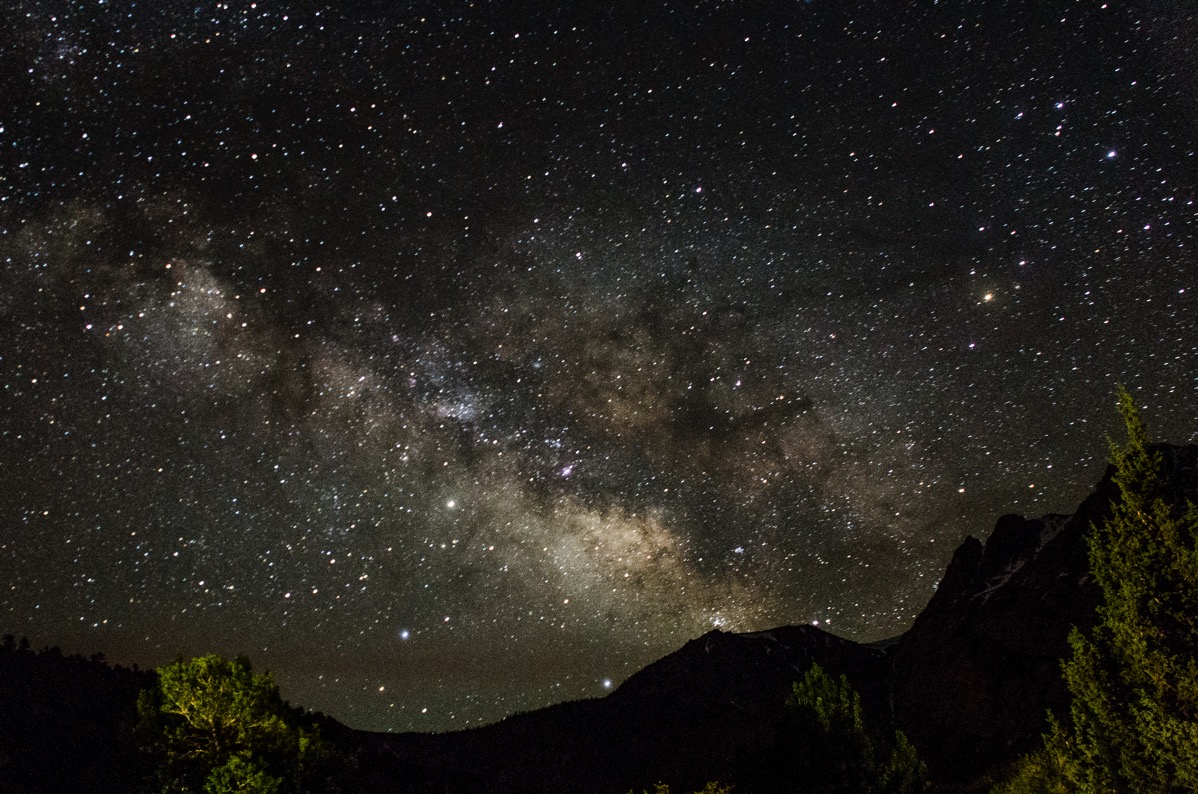
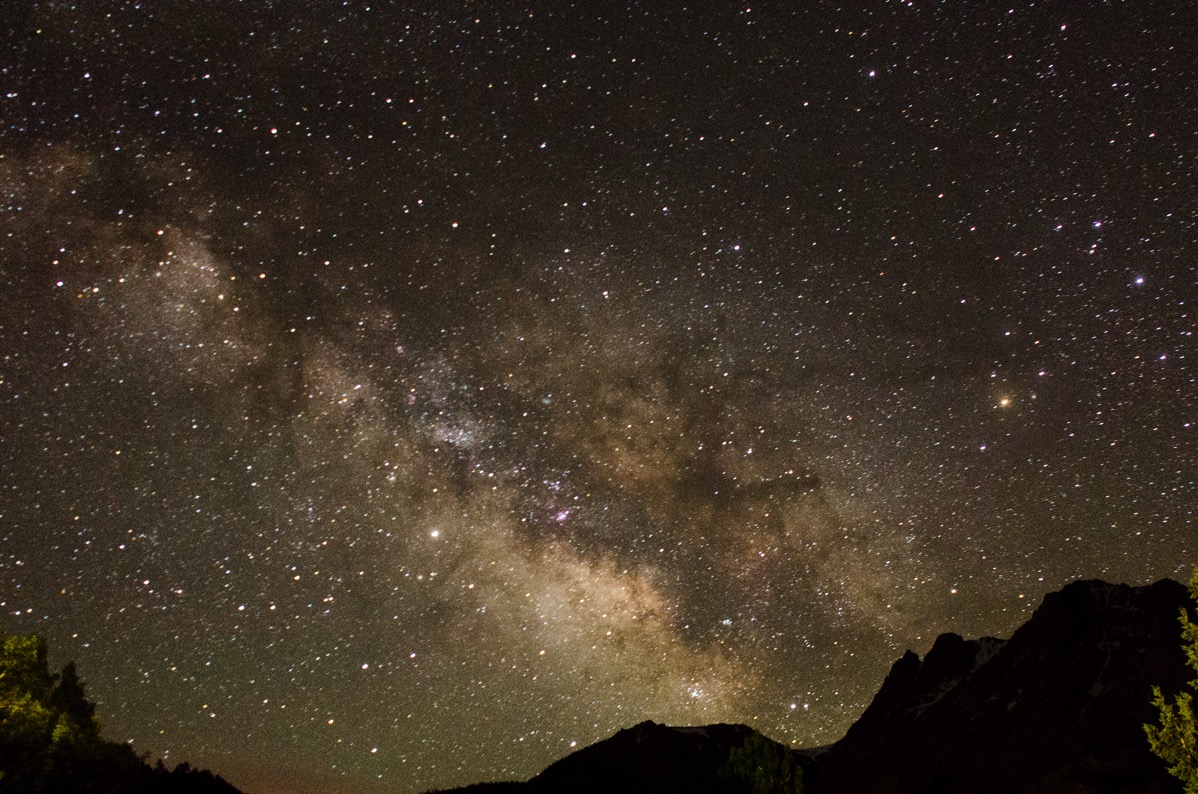
Looking at the milky way is an enlightening experience, especially if you know some of the science behind it. The Milky Way is the galaxy that contains our solar system. The milky color visible from earth comes from stars that cannot be individually distinguished by the naked eye. The view that we get of the galaxy does not even include phenomenons that we cannot observe: gamma-ray bursts, pulsars, black holes Looking at the milky way and contemplating how vast the universe is and how unique our blue dot is, is a very humanizing experience.


JUNE LAKE STARS 2
JUNE LAKE STARS 6
Defined tags for this entry:

revisiting the play Julius Caesar as an adult

I have had to read and take an exam on the play Julius Caesar. This had meant that I was forced to read the play and not see it performed. I had always assumed the play Shakespeare's Julius Caesar to be about the death (and life) of Julius Caesar. I got a chance to see the play performed by OSF and it has led me to question some ideas I had about the play.

Cassius was not Brutus's puppeteer

One of the impressions I had about Cassius was he was the villain in the play and he was the puppeter who was controlling Brutus's opinions about Caesar and inciting Brutus against Caesar. However, as the play progresses, it becomes clear that Cassius was not a scheming villain and he was perfectly happy to give Brutus the role of the leader of the assassination plot. This is very clear when he wholeheartedly agrees to not bring Cicero into the plot.

 CASSIUS


But what of Cicero? shall we sound him?
I think he will stand very strong with us.

CASCA

Let us not leave him out.

CINNA

No, by no means.

..

..

BRUTUS

O, name him not: let us not break with him;

For he will never follow any thing

That other men begin.

CASSIUS

Then leave him out.

The next time this happens is when Cassius warns Brutus to not let Marc Anthony speak

CASSIUS

Brutus, a word with you.

Aside to BRUTUS

You know not what you do: do not consent

That Antony speak in his funeral:

Know you how much the people may be moved

By that which he will utter?

BRUTUS

By your pardon;

I will myself into the pulpit first,

And show the reason of our Caesar's death:

What Antony shall speak, I will protest

He speaks by leave and by permission,

And that we are contented Caesar shall

Have all true rites and lawful ceremonies.

It shall advantage more than do us wrong.

CASSIUS

I know not what may fall; I like it not.

Another scene when this shines forth is the argument that Cassius and Brutus get into at the battlefield and Cassius offers Brutus his sword to kill Cassius. This way the argument ends shows Cassius

CASSIUS

Come, Antony, and young Octavius, come,

Revenge yourselves alone on Cassius,

For Cassius is aweary of the world;

Hated by one he loves; braved by his brother;

Cheque'd like a bondman; all his faults observed,

My spirit from mine eyes! There is my dagger,

And here my naked breast; within, a heart

BRUTUS

Sheathe your dagger:

Be angry when you will, it shall have scope;

Do what you will, dishonour shall be humour. 

Was the play about Caesar or about Brutus?

The other thing that stands out is that it is a little difficult to say Julius Caesar is the protagonist of the play. A lot of the play centers around the internal struggle that Brutus goes through before and after the assassination of Julius Caesar.  There are monologs where Brutus tries to resolve his doubts about assasinating his friend and a man who trusts Brutus.

One part that stands out is towards the end of the play, when Brutus comments on how good his life has been

BRUTUS

My heart doth joy that yet in all my life

I found no man but he was true to me.

I shall have glory by this losing day

More than Octavius and Mark Antony

By this vile conquest shall attain unto.

Even his enemies respected Brutus.

ANTONY

This was the noblest Roman of them all:

All the conspirators save only he

Did that they did in envy of great Caesar;

He only, in a general honest thought

And common good to all, made one of them.

This is in sharp contrast to the life of Julius Caesar who was assasinated by people who were close to him and thought of him as a tyrant. 

Defined tags for this entry: ,

Quote from "The Stranger" by Albert Camus

My dear,
In the midst of hate, I found there was, within me, an invincible love.
In the midst of tears, I found there was, within me, an invincible smile.
In the midst of chaos, I found there was, within me, an invincible calm.
I realized, through it all, that ...
In the midst of winter, I found there was, within me, an invincible summer.
And that makes me happy. For it says that no matter how hard the world pushes against me, within me, there's something stronger - something better, pushing right back.

Truly yours,
Albert Camus

Defined tags for this entry:

Is it the start of the American apocalypse?

From The Intercept's article "Donald Trump Will Be President. This is What We Do Next.", this section captures the most dominant thought I have:

Be not downhearted.

Don't give up. As bone-chilling as this moment is, it also proves that no one's in charge and just about everything in America's up for grabs. After all, Bernie Sanders looks like he's appearing in a role where the casting notice read: "Male, 70s, white, must look exactly like the caricature of a socialist from 1980s right-wing agitprop." Yet from a standing start he almost beat Hillary Clinton.

Young Americans are extremely progressive, so much so that Frank Luntz, the GOP's top pollster, says it should "frighten every business and political leader." To some degree we just need to engage in a holding action until they're running things.

Despite having no resources other than lots of cell phones with the Twitter app, Black Lives Matter has done more to blunt police brutality than anyone in the past 40 years. There should be classes taught around the world about how they're doing it.

However, there is a section of people who might be harmed by the administration. There is no easy way to predict what the targets would be and how they will be targeted. Fuckupbigots

Defined tags for this entry: ,

Page 1 of 3, totaling 20 entries