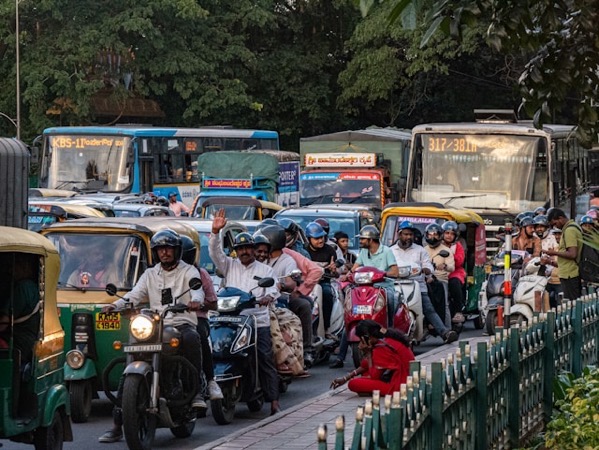
 Photo by Lukas Kienzler on Unsplash
I spent years losing time I'll never get back. In Bangalore, 117 hours a year stuck in traffic. In Delhi, 76 hours. That's nearly three full days annually spent breathing exhaust fumes, watching productivity evaporate, and feeling ambition slowly suffocate in gridlock.
This isn't just my story. It's the story of millions of Indians trapped in cities that generate wealth but can't govern themselves.
Last week's Economic Survey finally said what we've all been living: India's cities are "economically central but politically peripheral." The top 10 cities hold roughly 9% of the population but generate nearly 28% of GDP—a 3× output multiplier. Yet they raise less than 0.6% of GDP in own-source revenue. They can't tax. They can't borrow. They can't plan their own futures.
The survey's conclusion is damning: "Global cities compete; Indian cities comply."
We've Built a System That Punishes Success
Here's what that compliance looks like in practice: affordable housing in the top eight cities collapsed from 52% of new supply in 2018 to just 17% by 2025. People who build India's economic engine can't afford to live near where they work. So they move further out, where housing is cheaper and commutes are brutal. The congestion gets worse. The tax base hollows out. The cycle repeats.
Meanwhile, the Economic Survey gently suggests cities should "prioritize the movement of people, not vehicles." What it should say is this: we've turned our roads into parking lots for single-occupancy cars while buses remain inadequate and metro coverage stays patchy. First-mile and last-mile connectivity is still an afterthought. Other global cities introduced congestion pricing decades ago. We're still debating it.
Informality Isn't the Bug—It's the Only Thing That Works
The survey notes that "informality is not an aberration but a structural outcome of rapid urbanization under constrained formal systems." Translation: our formal systems are so broken that informal systems have to fill the gaps.
Door-to-door garbage collection covers 98% of wards today. Impressive statistic. But when informal sanitation workers left Gurugram during a labor dispute, garbage piled up overnight. The entire system depends on invisible labor that we refuse to properly integrate or compensate. We'd rather pretend informality doesn't exist than acknowledge that it's the only reason our cities function at all.
We're More Urban Than We Admit
Official Census data from 2011 claims India's urbanization rate is around 31%. Satellite data tells a different story: some regions are functionally above 80% urban when you measure actual settlement patterns instead of administrative boundaries. We're governing 21st-century megacities with frameworks designed for towns.
The Economic Survey concludes that cities need fiscal power, planning power, and enforcement power to move from managing growth to benefiting from it. I'd go further: until cities can tax properly, borrow meaningfully, reform land use, integrate transit, and take political ownership of outcomes, nothing will change. And nothing is changing.
Why I Left
I left India because I got tired of watching ambition collide with dysfunction. Tired of living far from work because that's where housing was affordable. Tired of infrastructure expanding while institutions stayed broken. Tired of hearing about potential that never materializes because the system is designed to disperse power and avoid accountability.
India will keep producing globally competitive talent from structurally constrained cities. And that talent will keep leaving—not because India lacks opportunity, but because its cities can't translate economic productivity into livable realities. Until that changes, the brain drain isn't a failure of ambition. It's a rational response to urban failure.