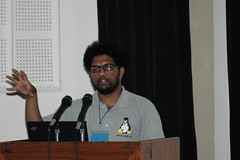
A catcher in the rye!

Ramkrsna
Originally uploaded by Premshree Pillai.
Ramki explaing some subtle points. However, just think of it as a demo of b**b-catching and laugh

Ramki explaing some subtle points. However, just think of it as a demo of b**b-catching and laugh
There has been a thread going on in the india-gii list about hiring and retaining talented coders in india. Here is the email that the original poster had posted
Over the past few weeks I've met with several people who are all having the same headaches1. Hiring talented coders 2. Retaining talented coders
The first is usually down to lack of talent (coders directly out of college just don't have the "new " skills (for example) in things like ajax, ruby, but have core knowledge of things like C, and what I call "old" languages), and also salaries wanted, especially if you are trying to sell abroad and compete with pricing abroad, i.e brazil, russia, ukraine offer lower prices these days.
My thoughts about this
When hiring freshers, I don't think you should look for what languages they know. Instead you should - try to gauge how much of the fundamentals they know - if they (freshers) are self-learnersPoint 1 can be checked by asking them about sorting/searching algorithms or networking or process management (basically the topics which are covered in their operating system course or their data structures course).
Point 2 can be checked by seeing if they have contributed to any free software project and actually asking them to show their code (it is after all free software and there is no NDA). If a fresher has worked on an open source project, it usually means - he knows about version control - he knows about mailing lists - he can work without much supervision - he can work with a distributed team - and most importantly, he can work with a team
In the email, the original poster had also mentioned this point
the big guns (tcs, infosys etc) hire like 10K users in a go, and its seems that the prospects of getting a good wife/husband are directly linked to the name of the company on the CV (again this maybe biased, but am seeing it more and more).
WTF!! ROTFL!! ![]()

I am Living on the edge. What about you ?
.
Dear Manager,
I thank you from the bottom of my heart for approvimg my request to move my work desktop to a RedHat system. FreeBSD4 sucks donkey balls (as Eric Cartman would say). Linux is so super-sweet (even if it is RHEL)
Now to move my home directory.
Your sincere slave
Raj Shekhar
Almost 2 months back, I got myself an ipod shuffle. After using it for
some time, I am totally in love with it. I can now understand why the
Macheads sell out their souls to Apple - the bargain is well worth it
.
I was thinking about why portable devices like ipod and mobile phones are so close to their owners and I came up with this list.
This list is just something to keep in mind when I am designing my Killer App (TM).
If you have not heard about
emacs
registers, you are missing a very powerful tool in your
arsenal. Think of registers as "clipboard" on steroids. I had been
using registers to store text -i.e. C-x r s a to copy
region into register "a" and C-x r i a to insert text
from register "a".
Today, while reading the gnu.emacs.help newsgroup, I came to know that you could save your current (emacs)frames layout to the register and then restore it back again.
`C-x r w R' Save the state of the selected frame's
windows in register R (`window-configuration-to-register').`C-x r j R' restore a window or frame configuration
stored in register R.Here is the email where I saw this.
Re: how to keep/restore my view and mode?
On 20 Sep 2006 22:23:54 -0700 Leo Hou wrote:> Dear all, > > I am not sure if I am using the right term of "view" and "mode". My > problem is as follows: > > I am using C-x 3 and "follow-mode" to view my source code. Every time I > compile, the other column becomes the result of make. I need to use a > lot of keys to switch it back to normal: C-x o; C-x k; C-x o; M-x > follow-mode > Is there a better way?
C-x r w <some letter or number> to store a window layout and C-x r j <the same number or letter> to restore it. And there is no need to kill the compilation buffer. It gets reused anyway.
David
Page 3 of 3, totaling 20 entries