The Hidden Tax on Indian Ambition
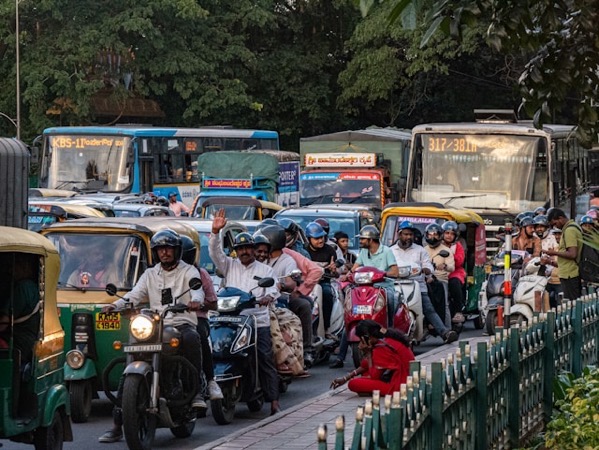
Lukas kienzler b3TAaBlBdps unsplash. Photo by Lukas Kienzler on Unsplash


I spent years losing time I'll never get back. In Bangalore, 117 hours a year stuck in traffic. In Delhi, 76 hours. That's nearly three full days annually spent breathing exhaust fumes, watching productivity evaporate, and feeling ambition slowly suffocate in gridlock.

This isn't just my story. It's the story of millions of Indians trapped in cities that generate wealth but can't govern themselves.

Last week's Economic Survey finally said what we've all been living: India's cities are "economically central but politically peripheral." The top 10 cities hold roughly 9% of the population but generate nearly 28% of GDP—a 3× output multiplier. Yet they raise less than 0.6% of GDP in own-source revenue. They can't tax. They can't borrow. They can't plan their own futures.

The survey's conclusion is damning: "Global cities compete; Indian cities comply."

We've Built a System That Punishes Success

Here's what that compliance looks like in practice: affordable housing in the top eight cities collapsed from 52% of new supply in 2018 to just 17% by 2025. People who build India's economic engine can't afford to live near where they work. So they move further out, where housing is cheaper and commutes are brutal. The congestion gets worse. The tax base hollows out. The cycle repeats.

Meanwhile, the Economic Survey gently suggests cities should "prioritize the movement of people, not vehicles." What it should say is this: we've turned our roads into parking lots for single-occupancy cars while buses remain inadequate and metro coverage stays patchy. First-mile and last-mile connectivity is still an afterthought. Other global cities introduced congestion pricing decades ago. We're still debating it.

Informality Isn't the Bug—It's the Only Thing That Works

The survey notes that "informality is not an aberration but a structural outcome of rapid urbanization under constrained formal systems." Translation: our formal systems are so broken that informal systems have to fill the gaps.

Door-to-door garbage collection covers 98% of wards today. Impressive statistic. But when informal sanitation workers left Gurugram during a labor dispute, garbage piled up overnight. The entire system depends on invisible labor that we refuse to properly integrate or compensate. We'd rather pretend informality doesn't exist than acknowledge that it's the only reason our cities function at all.

We're More Urban Than We Admit

Official Census data from 2011 claims India's urbanization rate is around 31%. Satellite data tells a different story: some regions are functionally above 80% urban when you measure actual settlement patterns instead of administrative boundaries. We're governing 21st-century megacities with frameworks designed for towns.

The Economic Survey concludes that cities need fiscal power, planning power, and enforcement power to move from managing growth to benefiting from it. I'd go further: until cities can tax properly, borrow meaningfully, reform land use, integrate transit, and take political ownership of outcomes, nothing will change. And nothing is changing.

Why I Left

I left India because I got tired of watching ambition collide with dysfunction. Tired of living far from work because that's where housing was affordable. Tired of infrastructure expanding while institutions stayed broken. Tired of hearing about potential that never materializes because the system is designed to disperse power and avoid accountability.

India will keep producing globally competitive talent from structurally constrained cities. And that talent will keep leaving—not because India lacks opportunity, but because its cities can't translate economic productivity into livable realities. Until that changes, the brain drain isn't a failure of ambition. It's a rational response to urban failure.

Defined tags for this entry: , ,

Happy Holi at Stanford, California, USA!

Holi is one of my favourite and I really love all aspects of it - colours, the burning of the bonfire the day before Holi (Holika Dahan), Bhang and the food! I had not had a good Holi celebration after I moved to Bangalore (2005).

However, I had a GREAT Holi yesterday when I joined thousands of others from Bay Area in the Asha Stanford's Holi celebration. I had tons of fun coloring my wife, friends and random folks, having yummy food and enjoying a beautiful day in the sun.

We had planned to take the train to one of our friend's (N) place and then accompany him and his wife to the Holi celebrations. The day started at 8 AM and we had a hiccup when we missed our train to get to our friend's place. We had to wait another hour to catch the next train. However, things started looking better after this incident. We ran into another acquintance Of ours on the train station and they got on the same train as us. We passed them a few tips about which places to visit in San Francisco (they were on their way to SF for some tourism).

We got down at our station and N. came down to pick us up. We went to his house, chit-chatted for a while and then started off for the venue to Stanford.

I was expecting a jolly good time and that is what I got :-) . The holi was in full swing when we got there. One of the playgrounds had been cordoned off for the holi festivities. We took our tickets and jumped into the festivities. There were lots of colors and lots of people. After we had colored each other, we started putting colors on random people. After 30 minutes with colors, it was difficult to recognize each other. There were some dance performances by some Stanford groups. And then the dancing started. And then we put color on more random people. The festivities ended around 3 PM. We had some food and then we came back home. Back home, we had to scrub ourself for around 15 minutes to clean out the colors, but it was a minor hassle.

Overall, I had a very good time and I hope to go back to the Holi celebrations again next year.

Defined tags for this entry: , ,

some commentary on Bangalore traffic

The most favorite activity that Bangaloreans indulge in is Trafficking. It is a social activity surpassing the bounds of caste, creed or religion. Every morning and evening all the people in Bangalore come out on to the streets with whatever vehicle(s) they own and create a mass procession. They honk, rev engines, brake hard, bump, double park, shout, jump traffic lights ... its a mass revelry. — Taken from Uncyclopedia

After living here for three and a half years, I think I can say with some authority that commuting in Bangalore is a daily adventure. Every day there is something unpredictable that will happen and will affect the flow of traffic. Either a truck would be parked on the wrong side of the road, or a car would have broken down, or the traffic police would mark one of the roads as one-way.

There is a "magic window" in the Bangalore traffic. This is the time when the traffic flows without the interruptions of the traffic police and the heavy trucks have not yet come out on the roads. If you are able to get to your destination in the magic window, your day will be relatively tension free.

The amount of time wasted on the streets is staggering. If we add the cost we pay in terms of health and peace of mind, the costs would be enormous. To give you an idea, the route to reach my office is around 12 kilometers from my home. However, it takes me around 30 minutes to cover this distance.

In my opinion, a two wheeler is the best way to navigate your way around Bangalore. It is easy to work your way around cars and trucks waiting at the traffic signal. Not to forget, the savings on the petrol bill.

Speaking of cars, I don't understand why people buy luxury cars in Bangalore. I have seen quite a few traffic snarls caused by one luxury car going slow or waiting to take a turn.

Anyhow, enough of my rantings.

Defined tags for this entry: , ,

hiring and retaining

There has been a thread going on in the india-gii list about hiring and retaining talented coders in india. Here is the email that the original poster had posted

Over the past few weeks I've met with several people who are all
having the same headaches

1. Hiring talented coders 2. Retaining talented coders

The first is usually down to lack of talent (coders directly out of college just don't have the "new " skills (for example) in things like ajax, ruby, but have core knowledge of things like C, and what I call "old" languages), and also salaries wanted, especially if you are trying to sell abroad and compete with pricing abroad, i.e brazil, russia, ukraine offer lower prices these days.

My thoughts about this

When hiring freshers, I don't think you should look for what languages
they know. Instead you should
- try to gauge how much of the fundamentals they know
- if they (freshers) are self-learners

Point 1 can be checked by asking them about sorting/searching algorithms or networking or process management (basically the topics which are covered in their operating system course or their data structures course).

Point 2 can be checked by seeing if they have contributed to any free software project and actually asking them to show their code (it is after all free software and there is no NDA). If a fresher has worked on an open source project, it usually means - he knows about version control - he knows about mailing lists - he can work without much supervision - he can work with a distributed team - and most importantly, he can work with a team

In the email, the original poster had also mentioned this point


the big guns (tcs, infosys etc) hire like 10K users in a go, and its
seems that the prospects of getting a good wife/husband are directly
linked to the name of the company on the CV (again this maybe biased,
but am seeing it more and more).

WTF!! ROTFL!! :-)

Defined tags for this entry: , , ,

why 'proud to be an indian' ?

The Hindu has a thought provoking article on Isarel's militarism. The most striking line in that article is in the first paragraph.

AS a Jew, I've been asked if I'm ashamed at what Israel has been doing in Lebanon. And the answer I give is that I am disgusted, I am angry, I am appalled, but, no, I am not ashamed. Why should I be? I bear no personal responsibility for this criminal activity — except, of course, in so far as I fail to take whatever action I can to stop it.

If you are on any of the mailing list or if you have had an email id for at least one year, you might have received an email titled "jai hind" or "proud to be an indian" around 15th August. The email has a bunch of questions and answers like

Q. Who is the creator of Pentium chip (needs no introduction as 90% of the today's computers run on it)?
A. Vinod Dahm
Q. Who is the founder and creator of Hotmail (Hotmail is world's No.1 web based email program)?
A. Sabeer Bhatia

and so on.

The email ends thus

Say proudly, I AM AN INDIAN. Please forward this email to all known INDIANS...............

I have always been baffled by this chest beating. As an Indian, why should I take credit for the success of Sabeer Bhatia, Azim Premji and Vinod Dahm - what contribution did I make to their success ?

I am totally unpatriotic.

Defined tags for this entry:

India may scrap gay sex law over HIV fears

Yahoo! news has a coverage about this

The government's main AIDS prevention agency has filed an affidavit in the Delhi High Court, supporting a request by an AIDS activist group to scrap the law.

The National AIDS Control Organization, part of India's Health Ministry, argued in the affidavit filed last week that the 1861 law creates a public health risk.

"So long as the gay community is forced to go underground, it limits the access to them and makes it difficult for the AIDS prevention campaign to reach them," Sujatha Rao, who heads the AIDS Control Organization, also known as NACO, told The Associated Press.

I hope this law gets scrapped. This is covered under the Section 377 of the Indian Penal Code (IPC) of 1860.

"of unnatural offences: Who ever voluntarily has carnal intercourse against the order of nature with any man, woman or animal shall be punished with imprisonment for life or imprisonment of either description for a term which may extend to 10 years and shall also be liable to fine.

Defined tags for this entry:

GNUnify 06

Last week, I had gone to GNUnify, a conference organized by Symbiosis(SICSR), Pune. I had spoken on webservices together with Gopalv and Premshree.

An interesting event we organized was a Birds of a Feather (BoF) meeting on "Why you should be a FOSS programmer" that we had with the students there. My first observation during the BoF was that most of the students had no idea what FOSS is. One of them actually thought that FOSS was a programming language. Most of them had been absolutely brain washed by MS propaganda or maybe they had been brainwashed by their teachers. Not may of them had used any of the P languages (Perl, PHP, Python). I asked them this question - "will you like to work for Yahoo!, Google or Amazon or will you like to work for another IT sweat shop? If you want to work with the big names, then you have to know the P languages". Gopalv, Premshree, Pankaj and Philip spoke about their respective projects, how they had gotten into free software and how it had helped them in getting jobs. Gopalv pointed out how our education system is flawed when it comes to exams and assignments. In a class, you have to beat the others to be called a achiever. In the real world, you have to work with others to come up with something good. Working with FOSS allows you to collaborate with others and have a taste of how things work in the real world.

Our main aim in organizing this BoF was to get even 2 students interested in FOSS. Sadly, I am sure we failed to do that :-( . However, we told the students about the mailing lists and irc channels that they could use to find help. I hope some of them eventually turn up there.

Danese was one of the speakers in this conference and she gave a good presentation on how to get into open source. Answering the audience questions on how to make money with Open Source, she said that Open Source allows you to make money by offering services, and India understands the service model well. This rankled me quite a bit. There aer ways to make money by selling FOSS products too - MySQL and SugarCRM being the prime examples. However, in India, you don't have any companies which make products. Lots of companies outsource their development work here, but except Tally (a closed source accounting software), I don;t know of any Indian companies making products. I am not sure why this is the way things are - one reason might be that product development is inherently a risky business. On the other hand, the payoff from a product is quite high.

I also met a bunch of people whom I knew only in the online world. We went to this amazing restaurant called "Horn OK Please". Even though we had to wait a bit to get the tables, it was really worth it. If you are in Pune, try out that restaurant.

All in all, I will say that this experience was really good. The students did excellent work in organizing the event, though I would have been happier if they participated in the event instead of just being a volunteer in it.

Defined tags for this entry: , ,

Page 1 of 2, totaling 14 entries