The Hidden Tax on Indian Ambition

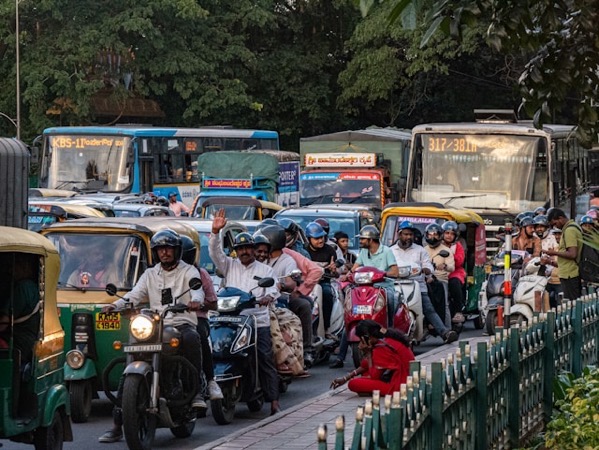
Lukas kienzler b3TAaBlBdps unsplash. Photo by Lukas Kienzler on Unsplash


I spent years losing time I'll never get back. In Bangalore, 117 hours a year stuck in traffic. In Delhi, 76 hours. That's nearly three full days annually spent breathing exhaust fumes, watching productivity evaporate, and feeling ambition slowly suffocate in gridlock.

This isn't just my story. It's the story of millions of Indians trapped in cities that generate wealth but can't govern themselves.

Last week's Economic Survey finally said what we've all been living: India's cities are "economically central but politically peripheral." The top 10 cities hold roughly 9% of the population but generate nearly 28% of GDP—a 3× output multiplier. Yet they raise less than 0.6% of GDP in own-source revenue. They can't tax. They can't borrow. They can't plan their own futures.

The survey's conclusion is damning: "Global cities compete; Indian cities comply."

We've Built a System That Punishes Success

Here's what that compliance looks like in practice: affordable housing in the top eight cities collapsed from 52% of new supply in 2018 to just 17% by 2025. People who build India's economic engine can't afford to live near where they work. So they move further out, where housing is cheaper and commutes are brutal. The congestion gets worse. The tax base hollows out. The cycle repeats.

Meanwhile, the Economic Survey gently suggests cities should "prioritize the movement of people, not vehicles." What it should say is this: we've turned our roads into parking lots for single-occupancy cars while buses remain inadequate and metro coverage stays patchy. First-mile and last-mile connectivity is still an afterthought. Other global cities introduced congestion pricing decades ago. We're still debating it.

Informality Isn't the Bug—It's the Only Thing That Works

The survey notes that "informality is not an aberration but a structural outcome of rapid urbanization under constrained formal systems." Translation: our formal systems are so broken that informal systems have to fill the gaps.

Door-to-door garbage collection covers 98% of wards today. Impressive statistic. But when informal sanitation workers left Gurugram during a labor dispute, garbage piled up overnight. The entire system depends on invisible labor that we refuse to properly integrate or compensate. We'd rather pretend informality doesn't exist than acknowledge that it's the only reason our cities function at all.

We're More Urban Than We Admit

Official Census data from 2011 claims India's urbanization rate is around 31%. Satellite data tells a different story: some regions are functionally above 80% urban when you measure actual settlement patterns instead of administrative boundaries. We're governing 21st-century megacities with frameworks designed for towns.

The Economic Survey concludes that cities need fiscal power, planning power, and enforcement power to move from managing growth to benefiting from it. I'd go further: until cities can tax properly, borrow meaningfully, reform land use, integrate transit, and take political ownership of outcomes, nothing will change. And nothing is changing.

Why I Left

I left India because I got tired of watching ambition collide with dysfunction. Tired of living far from work because that's where housing was affordable. Tired of infrastructure expanding while institutions stayed broken. Tired of hearing about potential that never materializes because the system is designed to disperse power and avoid accountability.

India will keep producing globally competitive talent from structurally constrained cities. And that talent will keep leaving—not because India lacks opportunity, but because its cities can't translate economic productivity into livable realities. Until that changes, the brain drain isn't a failure of ambition. It's a rational response to urban failure.


Defined tags for this entry: , ,


Notes on Delhi

"NewDelhi | 'Delhi is a city of secrets… everything's hidden, you need a good guide’ says US Ambassador"

Came across this  Indian Express article about the experiences of the American Ambassador to India and I was surprised on how closely it matches my own experiences and thoughts about Delhi.


If you want to experience humanity at its fullest, this is the city for you.

This is something that stood out.  Delhi shows you the full spectrum on humans in a day: You will see people on the streets - ignored by everyone and you will see politicians surrounded by 10s of escort cars.  You will see the fashion parade of people haggling for the latest trends in Sarojini Nagar, and then a family dressed in the most traditional on way to attend a wedding. You will encounter  pickpockets and  swindlers trying to one-up you and you will see a generous man feeding a street dog half his lunch.


Delhi is a city of secrets… everything’s hidden

.. in plain sight. It doesn’t explain itself, but if you’ve lived here long enough, you stop needing explanations. You start reading the city like a layered book—noise and grace, chaos and intimacy, pride and vulnerability, all crammed into the same lane.

For better or worse, Delhi teaches you how to pay attention.


Dying with Dignity or Dying for a Lack of Support?

The expansion of Canada's euthanasia law, also known as medically assisted death (MAID), has had unintended consequences for some people with disabilities. Bill C-14, passed in 2016, legalized euthanasia for people with a "reasonably foreseeable" death. An amendment to the law, Bill C-7, further expanded the scope of legal euthanasia to include individuals suffering unbearably from a serious and incurable illness, disease, or disability, even if their death is not reasonably foreseeable. While the intention behind the law was to help people die with dignity, it has had unintended consequences for some individuals who may choose to end their lives due to a lack of quality social services.

One example is Amir Farsoud, who has never-ending back pain that qualified him for euthanasia. Farsoud did not want to die, but after fearing he would lose his housing, he applied for MAID as an alternative to homelessness. He had already received the approval of one doctor and was waiting for the required 90 days to pass before obtaining the approval of a second doctor when his story was published. A GoFundMe campaign raised more than $60,000 from people around the world and has given him a new lease on life. Farsoud has since put his application for MAID away, but his story has raised questions about the ethics of applying for MAID due to poverty.

Another example is a Canadian Forces veteran who suffered from traumatic brain injury and post-traumatic stress disorder (PTSD) and was casually offered euthanasia by a Veterans Affairs employee. These cases illustrate the potential risks of the expanded euthanasia law in Canada and raise concerns about the impact on individuals with disabilities who may not have access to quality social services.

In conclusion, while the intention behind MAID is to help people die with dignity, it is important to consider the potential unintended consequences of the law. In light of these examples, it is clear that more guardrails are needed to ensure that MAID is not being used as a shortcut to stop supporting citizens in Canada, particularly those who are chronically ill and unable to afford housing.


Milky Way

Looking at the milky way is an enlightening experience, especially if you know some of the science behind it. The Milky Way is the galaxy that contains our solar system. The milky color visible from earth comes from stars that cannot be individually distinguished by the naked eye. The view that we get of the galaxy does not even include phenomenons that we cannot observe: gamma-ray bursts, pulsars, black holes Looking at the milky way and contemplating how vast the universe is and how unique our blue dot is, is a very humanizing experience.


JUNE LAKE STARS 2
JUNE LAKE STARS 6
Defined tags for this entry:

Did Terry Pratchett put a part of himself in Sam Vimes

I was reading Neil Gaiman's eulogy for Terry Pratchett. This part stood out to me:

Terry looked at me. He said: "Do not underestimate this anger. This anger was the engine that powered Good Omens." I thought of the driven way that Terry wrote, and of the way that he drove the rest of us with him, and I knew that he was right.

There is a fury to Terry Pratchett's writing: it's the fury that was the engine that powered Discworld. It's also the anger at the headmaster who would decide that six-year-old Terry Pratchett would never be smart enough for the 11-plus; anger at pompous critics, and at those who think serious is the opposite of funny; anger at his early American publishers who could not bring his books out successfully.

And that anger, it seems to me, is about Terry's underlying sense of what is fair and what is not. It is that sense of fairness that underlies Terry's work and his writing, and it's what drove him from school to journalism to the press office of the SouthWestern Electricity Board to the position of being one of the best-loved and bestselling writers in the world.

This description of Terry Pratchett reminded me of the character Sam Vimesfrom the Discworld series. Vimes is an idealist, but a committed cynic whose knowledge of human nature constantly reminds him how far off those ideals are. Vimes also has a dark side that comes out when Vimes loses control of his anger, especially when he temporarily lets go of "the Beast" (in the novel Thud!).

Defined tags for this entry: ,

Page 1 of 17, totaling 117 entries