Archive.today CAPTCHA page executes DDoS

Mind blown by this sneakiness 

Wikipedia editors are discussing whether to blacklist Archive.today because the archive site was used to direct a distributed denial of service (DDoS) attack against a blogger who wrote a post in 2023 about the mysterious website’s anonymous maintainer.

Checking on the In a request for comment page on Wikipedia

Over 400,000 pages currently contain over 695,000 links to Archive.today

In January 2026, the maintainers of Archive.today inserted malicious code in order to perform a distributed denial of service attack against a person they were in dispute with. Every time a user encounters the CAPTCHA page, their internet connection is used to attack a certain individual's blog.

Defined tags for this entry: ,

The Governor is Gone

From AI fatigue is real and nobody talks about it

Here's the thing that broke my brain for a while: AI genuinely makes individual tasks faster. That's not a lie. What used to take me 3 hours now takes 45 minutes. Drafting a design doc, scaffolding a new service, writing test cases, researching an unfamiliar API. All faster.

[..]

But my days got harder. Not easier. Harder.

[..]

Before AI, there was a ceiling on how much you could produce in a day. That ceiling was set by typing speed, thinking speed, the time it takes to look things up. It was frustrating sometimes, but it was also a governor. You couldn't work yourself to death because the work itself imposed limits.

AI removed the governor. Now the only limit is your cognitive endurance. And most people don't know their cognitive limits until they've blown past them.


Defined tags for this entry: , ,

ops is not a dirty word

From https://charity.wtf/2026/01/19/bring-back-ops-pride-xpost/

What’s wrong with operations? Ops is not a synonym for toil; it literally means “get shit done as efficiently as possible”. Every function has an operational component at scale: business ops, marketing ops, sales ops, product ops, design ops and everything else I could think of to search for, and so far as I can tell, none of them are treated with anything like the disrespect, dismissal and outright contempt that software engineering

Defined tags for this entry: , , , , ,

Using llm to understand large codebases

From Martin Fowler :

One attendee is an SRE for a Very (Very) Large Code Base. He was less worried about people not understanding the code an LLM writes because he already can’t understand the VVLCB he’s responsible for. What he values is that the LLM helps him understand the what the code is doing, and he regularly uses it to navigate to the crucial parts of the code.

There’s a general point here:

Fully trusting the answer an LLM gives you is foolishness, but it’s wise to use an LLM to help navigate the way to the answer.

Defined tags for this entry: , , ,

How to use flight tail numbers to track flights

This is a useful tool for people to check the status of a commercial flight using the tail number of the airplane, without the need to subscribe to any services. As a passenger, this is useful because you can see where the airplane scheduled to fly you is currently, which can help keep track of delays and cancellations.

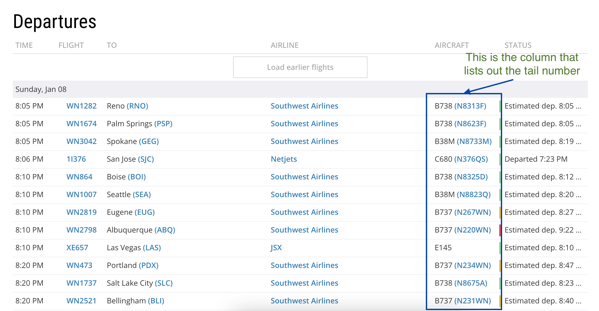
The first step is to find the tail number of the flight that you are scheduled to take. Head to the airports page of flightradar24 and get to the page of the airport that you will be flying out of. For example, if you are flying out of Oakland, California, this would be https://www.flightradar24.com/data/airports/oak. On that page, click the "Departures" tab. This will give a list of flights, along with their tail numbers.
Screen Shot 2023-01-08 at 8.23.29 PM.png

For example, assuming that you are flying on the 8:05 PM Southwest flight to Reno (WN1282), the tail number is under the "Aircraft" column (N8313F).

Once you have the tail number, you can use flightaware.com to track the schedule, current location, flight path. Just put the tail number into the search box. Another useful tool is airfleets.com, which can show complete airplane details, as well as links to adsbexchange.

Defined tags for this entry: ,

Did Terry Pratchett put a part of himself in Sam Vimes

I was reading Neil Gaiman's eulogy for Terry Pratchett. This part stood out to me:

Terry looked at me. He said: "Do not underestimate this anger. This anger was the engine that powered Good Omens." I thought of the driven way that Terry wrote, and of the way that he drove the rest of us with him, and I knew that he was right.

There is a fury to Terry Pratchett's writing: it's the fury that was the engine that powered Discworld. It's also the anger at the headmaster who would decide that six-year-old Terry Pratchett would never be smart enough for the 11-plus; anger at pompous critics, and at those who think serious is the opposite of funny; anger at his early American publishers who could not bring his books out successfully.

And that anger, it seems to me, is about Terry's underlying sense of what is fair and what is not. It is that sense of fairness that underlies Terry's work and his writing, and it's what drove him from school to journalism to the press office of the SouthWestern Electricity Board to the position of being one of the best-loved and bestselling writers in the world.

This description of Terry Pratchett reminded me of the character Sam Vimesfrom the Discworld series. Vimes is an idealist, but a committed cynic whose knowledge of human nature constantly reminds him how far off those ideals are. Vimes also has a dark side that comes out when Vimes loses control of his anger, especially when he temporarily lets go of "the Beast" (in the novel Thud!).

Defined tags for this entry: ,

Page 1 of 15, totaling 104 entries